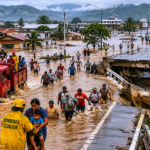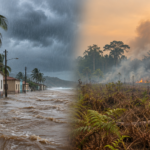
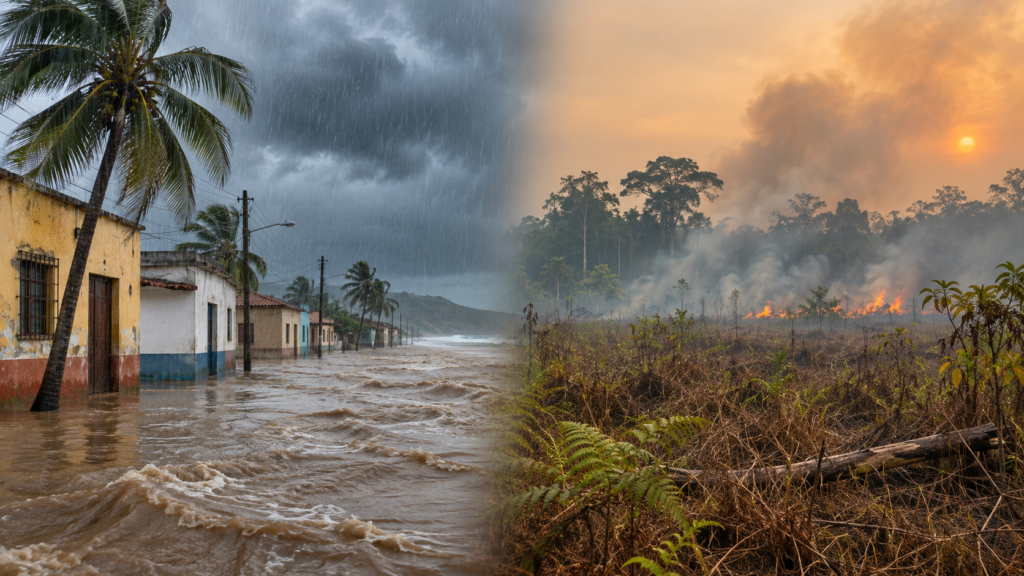
AI-generated illustration of the contrasting flood and wildfire risks associated with El Niño; not a photograph of specific events.
El Niño travel risks are moving from seasonal forecasts into reports of flooding, evacuations, and destructive fires. Since Mundo Travel News examined the outlook on September 27, northern Peru has suffered damaging rain, Indonesia has reported hundreds of homes destroyed by wildfire, and parts of the southwestern United States have experienced severe flooding.
The connection requires care: El Niño changes the conditions in which extreme weather develops. It does not explain every flood or fire on its own, and a regional emergency does not mean an entire country is unsafe to visit.
Northern Peru: Damaging Rain Arrives
In Peru’s Piura region, heavy rain on October 20 damaged homes, transportation infrastructure, schools, and drainage systems, according to the country’s National Civil Defense Institute, INDECI. Its November 4 update documented impacts in Piura, Castilla, Catacaos, Chulucanas, and other communities, followed by additional damage in Ayabaca on October 25.
The disruption provides a concrete example of the coastal flooding risk highlighted in our September report. For visitors, the immediate concern is access: urban flooding and damaged roads can interrupt transfers even when accommodation remains open.
On October 22, Peru’s meteorological service, SENAMHI, warned that another rainfall episode could bring around 80 millimeters a day in parts of Tumbes and more than 50 millimeters in parts of Piura. Those figures were forecasts for October 24–26, rather than confirmed rainfall measurements. The agency issued the warning in the context of the 2026–2027 coastal El Niño and projected more frequent, stronger rain from November.
Travelers planning northern coastal itineraries should check current road conditions and local warnings before each transfer. These reports concern specific northern communities; they do not establish equivalent disruption in Lima, Cusco, or Machu Picchu.
Indonesia: Wildfire Destroys Hundreds of Homes
Indonesia is experiencing the dry side of the Pacific climate pattern.
Reuters reported on October 12 that a fire in Serdang village, South Bangka, destroyed 305 houses and forced about 500 people to evacuate. Local disaster officials identified strong winds, peatland, limited water supplies, and wooden construction as factors that complicated firefighting.
El Niño’s broader influence is consistent with this heightened fire risk: NOAA’s October assessment documented suppressed rainfall-producing convection over Indonesia. That background favors drying, although it does not identify what ignited a particular fire.
For travelers, the practical concern extends beyond flames to smoke and changing air quality. Check conditions at your destination and along connecting routes, especially before outdoor excursions. The Bangka emergency should not be treated as evidence that Bali or every Indonesian island is experiencing the same conditions.
U.S. Southwest: Floods Force Evacuations
The southwestern United States has also experienced serious disruption.
Associated Press reporting published November 2 described flash floods that prompted evacuations in northern New Mexico and central Arizona. Climate specialists interviewed for the report said the unusually warm Pacific was increasing atmospheric moisture and helping steer conditions favorable for heavy rain toward the Southwest. They emphasized that El Niño was one contributor, not the sole cause.
Separate AP reporting documented flooding in Pagosa Springs, Colorado, evacuations along rivers, and closures affecting roads and recreation sites.
For visitors touring the Four Corners region, these events show why a desert itinerary still requires flood planning. Confirm campground, trail, and highway access with local authorities, allow flexibility between stops, and follow evacuation instructions.
East Africa: A Continuing Warning
East Africa remains a region to watch, but forecasts should be distinguished from documented new disasters.
The World Meteorological Organization’s regional outlook favors unusually wet conditions during the October–December rains. FAO has also warned of significant flooding potential in Somalia, including the Juba and Shabelle catchments.
For safari travelers, the relevant questions are local: whether access roads remain passable, whether river crossings are operating, and whether a lodge has alternative transfer arrangements. A seasonal outlook alone cannot establish that a particular park or lodge is flooded.
The Risk Extends Into 2027
NOAA’s October 8 assessment said El Niño was strengthening and gave a greater than 83% chance that strong-to-very-strong conditions would continue through January–March 2027. Its next monthly assessment is scheduled for November 12.
For travelers, the emerging lesson is to combine seasonal awareness with current local information. Before departure, verify transport access, weather alerts, and cancellation terms. During a trip, recheck conditions before long transfers or remote excursions: the most consequential disruption may be on the road between destinations.
Sources
NOAA ENSO Diagnostic Discussion, October 8, 2026:
https://cpc.ncep.noaa.gov/products/analysis_monitoring/enso_advisory/ensodisc.shtml
INDECI Piura emergency update, November 4, 2026:
https://portal.indeci.gob.pe/emergencias/reporte-complementario-n-o-14662-21-10-2026-coen-indeci-1029-horas-reporte-n-1-lluvias-intensas-en-el-distrito-de-sicchez-piura/
SENAMHI rainfall warning, October 22, 2026:
https://www.gob.pe/institucion/senamhi/noticias/1461321-senamhi-advierte-lluvias-de-mayor-intensidad-en-la-costa-norte-entre-el-24-y-el-26-de-octubre
Reuters, via MarketScreener, October 12, 2026:
https://www.marketscreener.com/news/wildfires-spread-into-residential-areas-in-indonesia-s-bangka-belitung-destroying-over-300-houses-ce785ddcde8cf126
Associated Press, via ABC News, November 2, 2026:
https://abcnews.com/amp/US/wireStory/el-nio-making-storms-flash-floods-southwest-worse-137782178
Associated Press, via The Philadelphia Inquirer, November 2, 2026:
https://www.inquirer.com/news/nation-world/southwest-flooding-evacuations-voting-arizona-colorado-new-mexico-20261102.html
WMO Greater Horn of Africa outlook:
https://wmo.int/media/news/el-nino-impacts-greater-horn-of-africa
FAO Somalia flooding warning:
https://www.fao.org/somalia/news/details/strong-el-ni%C3%B1o-weather-condition-raises-risk-of-severe-deyr-flooding-in-somalia–fao-warns/en/
September 27 Mundo Travel News article:
https://mundotravelnews.com/2026/09/27/https-mundotravelnews-com-el-nino-travel-weather-2026-2027/
About The Author