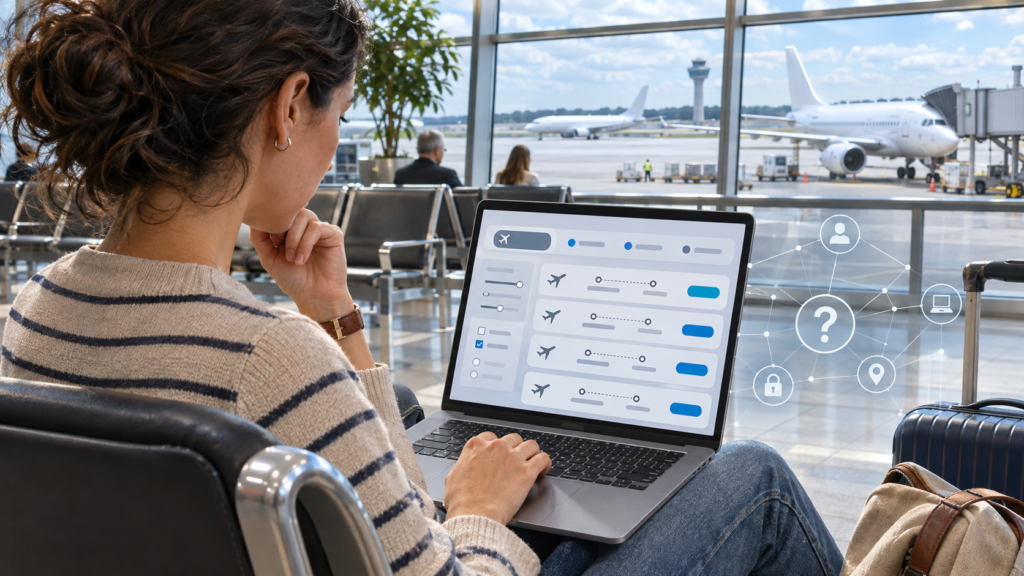
Illustration: Airline pricing systems are facing questions about personal data and fare ransparency.
November 6, 2026 | Mundo Travel News
U.S. regulators are examining whether airlines use personal information to set ticket prices. The inquiry raises questions about privacy and airfare transparency, but it does not establish that the carriers are charging passengers individualized fares.
Airline surveillance pricing is facing renewed scrutiny after the Federal Trade Commission ordered Delta Air Lines, United Airlines, and JetBlue to disclose how they set prices.
The October inquiry asks whether companies use personal information to determine what individual customers pay. For travelers, the concern is straightforward: could a booking system charge more because it believes a particular passenger can afford it, or urgently needs to travel?
The FTC is seeking evidence, rather than announcing a finding of wrongdoing. Delta has explicitly denied using personal data to set individualized airfares. [1][2]
What Is Airline Surveillance Pricing?
Surveillance pricing uses information about a customer to help determine the price or promotion that person receives. Potential inputs include location, browsing activity, shopping history, and other information that can reveal preferences or purchasing behavior.
The concern is that a seller could use those details to estimate a shopper’s willingness to pay, then tailor an offer accordingly.
In January 2025, FTC staff described how pricing intermediaries could draw on extensive consumer information, including precise location, browser history, and even mouse movements. The agency also identified tools that could change which products shoppers see.
Those findings concerned the broader pricing technology market. They were not proof that a particular airline was using those techniques. The public report used hypothetical examples to protect confidential business information. [3]
How It Differs From Dynamic Airfares
Airlines have long adjusted fares as demand, competition, and seat availability change. That process, generally called dynamic pricing, can produce different prices for the same flight at different times.
An inexpensive fare may disappear when its available inventory sells out. Prices can also differ because one ticket includes checked baggage, flexibility, or other benefits that another excludes.
Surveillance pricing raises a different question: whether information about the shopper helps determine the price offered, beyond the trip and ticket conditions selected.
Artificial intelligence alone does not establish that this is happening. An AI system can analyze demand across a route without using an individual passenger’s browsing history or financial circumstances.
Delta says its pricing technology uses aggregated information to support analysts, with recommendations that can raise or lower fares. The carrier identifies demand, competing offers, operating costs, and other market conditions as pricing factors. [2]
Why Airlines Are Under Scrutiny
The debate predates the latest FTC action. In August, Representative Frank Pallone requested information from eight major U.S. airlines about surveillance pricing, citing concerns that consumer information could be used to manipulate offers.
The requests went to Alaska, American, Delta, Frontier, Hawaiian, JetBlue, Southwest, and United. Pallone asked the companies to explain their practices; the inquiry itself did not demonstrate that they were using surveillance pricing. [4]
The FTC’s subsequent study reaches beyond aviation. Its orders also cover Uber, Lyft, DoorDash, Instacart, Target, and Walmart. Recipients have 45 days from receipt to respond.
The agency says it wants information directly from businesses setting consumer prices. Its announcement also references an August proposal addressing potentially deceptive, undisclosed personalized pricing. A proposed policy should not be confused with a finalized rule or an industrywide ban. [1]
What Delta Says About Personal Data
In a letter published in August 2025, Delta said it had never used, was not testing, and did not plan to use fare products that set individualized prices based on personal data.
The airline also said it did not share personal information with Fetcherr, the company developing its AI pricing recommendation technology. Delta described that technology as supporting employees who oversee pricing decisions. [2]
These statements are the airline’s account of its practices. The regulatory inquiry provides an opportunity to examine how pricing systems operate, rather than relying solely on public assurances or allegations.
What Travelers Can Do Now
A changing airfare is not, by itself, evidence of surveillance pricing. Travelers comparing offers should first make sure they are comparing the same product.
- Match the details. Check the flight, travel dates, passenger count, cabin, fare conditions, baggage allowance, and currency.
- Compare close together. Record competing offers within a short period to reduce the chance that inventory changes explain a difference.
- Check the airline directly. Compare its total with booking platforms, including fees and optional extras.
- Document unexplained differences. Save screenshots showing the time, itinerary, seller, and final price before drawing conclusions.
- Treat private browsing as a comparison tool. It doesn’t guarantee a lower fare or explain why two offers differ.
For international travelers, currency conversions and country-specific offers deserve particular attention. An apparent price gap may disappear once you factor in conversion costs and ticket conditions.
The immediate development is greater scrutiny of how fares are calculated. Travelers should watch for the inquiry’s findings while continuing to compare complete, equivalent offers. The central question remains whether personal information influences the price presented to an individual passenger—and what evidence companies provide to answer it.
Sources
[1] Federal Trade Commission, October 2026 personalized pricing inquiry:
https://www.ftc.gov/news-events/news/press-releases/2026/10/ftc-launches-personalized-pricing-compensation-inquiry
[2] Delta Air Lines, response on AI pricing, August 7, 2025:
https://news.delta.com/delta-responds-misinformation-around-ai-pricing
[3] Federal Trade Commission, January 2025 surveillance pricing findings:
https://search.ftc.gov/news-events/news/press-releases/2025/01/ftc-surveillance-pricing-study-indicates-wide-range-personal-data-used-set-individualized-consumer
[4] House Energy and Commerce Committee Democrats, August 12, 2026 airline inquiry:
https://democrats-energycommerce.house.gov/media/press-releases/pallone-presses-us-airlines-answers-surveillance-pricing
About The Author