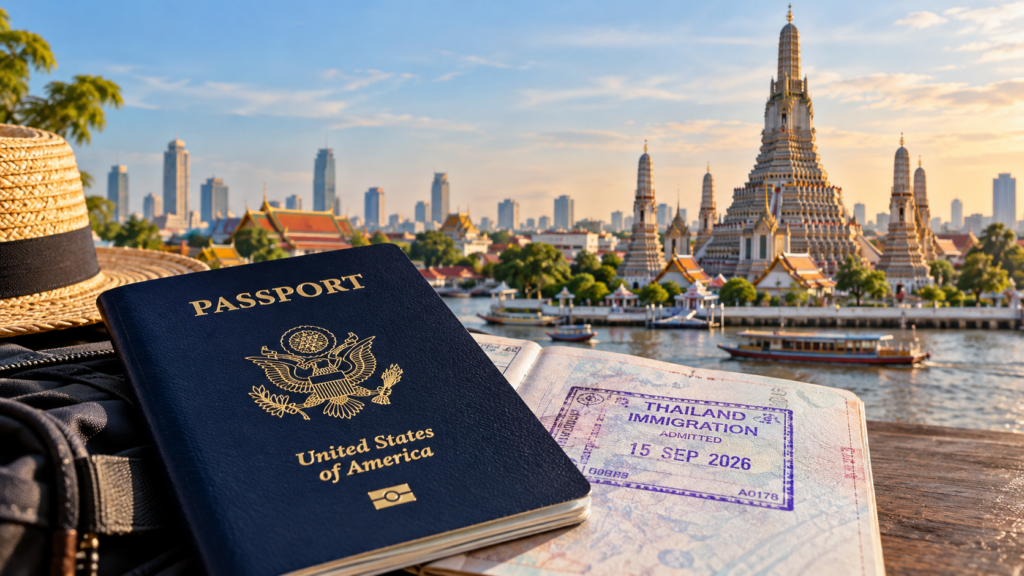
Thailand has replaced its 60-day tourist visa exemption with a 30-day visa-free stay for travelers from the United States and dozens of other countries.
Thailand visa-free stay: Thailand has ended its generous 60-day visa-free entry program, cutting the standard visa-exempt stay to 30 days for travelers from the United States, Canada, the United Kingdom, Australia, and dozens of other countries.
The change took effect September 15, 2026, following publication of the new rules in Thailand’s Royal Gazette on August 31.
For most vacationers, the change will make little difference. Americans visiting Thailand for two or three weeks can still arrive without obtaining a tourist visa in advance.
For long-term travelers, however, the difference could be significant.
Thailand visa-free stay: 60 Days Becomes 30
Thailand previously allowed citizens of 93 countries and territories to enter under a 60-day visa-exemption program.
That program has now been revoked.
Under the replacement system, passport holders from 60 countries and territories can enter Thailand visa-free for tourism for up to 30 days. The list includes the United States, Canada, the United Kingdom, Australia, New Zealand, Japan, and all 27 European Union countries.
Thailand says the changes were based on several considerations, including national security, tourism and economic interests, reciprocity between countries, and eliminating overlapping visa programs that could confuse visitors.
The government has also acknowledged concerns about misuse of visa privileges.
Travelers who entered Thailand before September 15 under the old system are not being forced to leave after 30 days. They may remain until the departure date authorized when they entered the country.
Can Travelers Stay Longer Than 30 Days?
Yes.
The Royal Thai Embassy in Washington says travelers admitted under the 30-day visa exemption may apply for an extension of up to another 30 days.
However, an extension isn’t guaranteed. Approval remains at the discretion of Thai immigration authorities.
Travelers who know in advance that they intend to spend considerably longer in Thailand may therefore be better served by obtaining an appropriate visa rather than relying on visa exemptions and extensions.
Thailand’s increasingly accessible e-Visa system is one reason the government cited for changing the exemption program.
Visa Runs Face Additional Restrictions
The new rules are particularly relevant to long-term visitors who have traditionally used border crossings to extend their time in Thailand.
Travelers entering through land-border immigration checkpoints using the 30-day visa exemption are generally limited to two such entries per calendar year.
Exceptions apply to citizens of Malaysia, Brunei, Indonesia, and Singapore, and Thailand can designate additional exceptions.
The rule makes repeated overland “visa runs” into neighboring Cambodia, Laos, and Malaysia a less practical strategy for foreigners effectively living in Thailand while using tourist exemptions.
Americans Still Don’t Need a Tourist Visa for Short Trips
For the typical American tourist, relatively little has changed.
A U.S. passport holder planning a two-week vacation in Bangkok, Chiang Mai, Phuket, or elsewhere in Thailand can still enter without obtaining a tourist visa beforehand.
The major difference appears when the trip exceeds 30 days.
Someone planning a six-week trip, for example, can no longer simply arrive under the previous 60-day exemption and remain for the entire vacation without taking additional action.
Travelers using the exemption should also be prepared to demonstrate that they meet Thailand’s entry requirements. Thai diplomatic guidance states that travelers may be required to have adequate funds and evidence of onward or return travel.
Don’t Forget the Thailand Digital Arrival Card
Visa-free does not mean paperwork-free.
All non-Thai nationals entering Thailand must complete the Thailand Digital Arrival Card, or TDAC, before arrival.
The electronic form replaced Thailand’s old paper arrival card in May 2025 and applies to travelers arriving by air, land, or sea.
Travelers submit the TDAC online during the three days before arriving in Thailand. There is no charge for submitting it through Thailand’s official immigration website.
The TDAC is not a visa and should not be confused with Thailand’s visa or visa-exemption requirements.
Why Thailand Changed the Rules
Thailand dramatically liberalized its entry policies as it worked to rebuild international tourism following the pandemic.
The government is now attempting to balance easy access for conventional tourists with tighter controls over foreigners using tourist privileges for longer stays.
Thailand’s government has specifically said the revision is not intended to discourage tourism. Instead, officials say the changes are designed in part to prevent visa privileges from being misused for illegal activities.
The result is a system that remains remarkably simple for someone spending a few weeks on a Thai beach but requires more planning for someone hoping to spend several months in the country.
For millions of ordinary tourists, Thailand remains visa-free.
They just have 30 days instead of 60.
About The Author