American travel to Europe 2026: Will Europe Get Cheaper for Americans Travelers?

September 2026
Americans considering a European vacation this winter or next spring face an unusually complicated travel outlook regarding American travel to Europe 2026.
Concerns about the U.S. economy are increasing, American interest in European travel has already softened, and geopolitical uncertainty continues to affect fuel prices and airfares, especially for those focusing on American travel to Europe 2026. At the same time, the dollar, European hotel prices, overtourism and new border requirements could all change the cost and experience of a European vacation.
Yet some of these developments could actually benefit Americans who remain willing and financially able to travel.
If U.S. demand falls, airlines and hotels may have to compete for fewer American customers, potentially producing lower fares and better availability. The question is whether those savings will outweigh a weaker dollar and Europe’s still-high travel costs.
Recession Isn’t the Only Number That Matters
The U.S. economy has slowed, increasing speculation about a possible recession during late 2026 or early 2027. But for international travelers, whether economists eventually declare a recession may be less important than what happens to their personal finances.
International leisure travel is disproportionately purchased by middle- and upper-income households. Those travelers are often influenced not only by employment but by the value of retirement accounts, investments and other assets.
A mild recession accompanied by a stable stock market might have surprisingly little effect on European tourism. A 20% or 25% stock-market decline could be different, even without a formal recession.
People don’t have to lose their jobs to postpone a $7,000 or $10,000 European vacation. Feeling significantly poorer can be enough.
There are already signs of caution. European Travel Commission research earlier this year found that only 32% of surveyed Americans were considering a long-haul trip to Europe, compared with 42% across the international markets studied. Time and money, rather than politics, were among the primary constraints.
The Dollar Could Be the Biggest Factor
For Americans who do travel, the dollar may ultimately matter more than GDP.
If a traveler expects to spend the equivalent of $5,000 on European hotels, meals, trains and attractions, a 10% decline in the dollar could add roughly $500 to the cost, assuming European prices remain unchanged.
Conversely, a stronger dollar effectively puts Europe on sale.
That means travelers considering Europe during the next six to nine months should pay attention to the EUR/USD exchange rate rather than focusing exclusively on recession forecasts.
A weakening U.S. economy could eventually lead to lower interest rates and pressure on the dollar. But persistent inflation could keep U.S. rates higher, making the currency outlook unusually difficult to predict.
Airfares Could Present an Opportunity
Weaker American demand could create bargains in one important area: transatlantic airfare.
American bookings to Europe were already showing weakness earlier this year. European Travel Commission data cited by Reuters showed U.S. bookings to Europe down 7.3%, even as overall European tourism continued to expand.
If demand deteriorates further, airlines could find themselves with seats they need to fill during winter and spring.
That doesn’t guarantee cheap flights. Airlines can eventually reduce capacity, and higher fuel prices can push fares in the opposite direction.
But there could be a period when already-scheduled airline capacity collides with weaker demand. Flexible travelers could benefit considerably, particularly those willing to choose their destination based on airfare rather than deciding on one city and one set of dates in advance.
Hotels May Not Follow Airfares Down
Accommodation presents a different problem.
Europe remains extremely popular. International arrivals increased about 5% during the first part of 2026, and four out of five European destinations reporting results recorded growth.
Domestic European demand is also strong. More than 80% of Europeans surveyed by the European Travel Commission planned to travel between June and November, with affordability increasingly influencing their decisions.
That means fewer Americans wouldn’t necessarily empty hotels in Paris, Rome, Barcelona or Amsterdam.
Secondary cities could be different. Destinations more dependent on long-haul visitors may offer better deals if U.S. demand weakens.
For Americans willing to venture beyond Europe’s most famous destinations, 2027 could therefore present some interesting opportunities.
Overtourism Matters More Than Anti-American Sentiment
European attitudes toward the United States have deteriorated, and political disagreements between Washington and European governments are real.
But travelers should distinguish between attitudes toward the United States and attitudes toward individual Americans.
There is much stronger evidence that residents of some European destinations are frustrated with tourism itself.
Protests against overtourism have occurred in numerous European cities, particularly in Spain, where demonstrations have taken place in more than 40 cities. Housing costs, short-term rentals, crowding and pressure on local infrastructure are among the major complaints.
American travelers are unlikely to be the specific target, but they are part of a tourism industry increasingly being questioned by local residents.
Choosing smaller cities, traveling outside peak periods and avoiding accommodation that contributes to housing shortages may increasingly improve both the travel experience and interaction with residents.
Europe Is Also Changing How Americans Enter
Americans traveling during this period also need to watch Europe’s new border systems.
The EU’s ETIAS travel authorization is scheduled to begin during the final quarter of 2026. The EU says travelers do not need to do anything yet and that the specific launch date will be announced before the system begins. Once operational, the application fee will be €20.
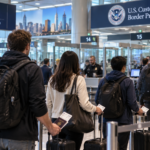
Europe’s separate biometric Entry/Exit System also represents a significant change at Schengen borders. Travel-industry research has warned that lengthy processing delays could discourage some visitors if implementation problems persist.
Neither system should discourage Americans from visiting Europe, but travelers should check official EU information before departure rather than relying on third-party ETIAS websites.
So, Will Europe Become Cheaper?
Possibly — but only under the right combination of circumstances.
The ideal scenario for American travelers would be weaker U.S. travel demand accompanied by a relatively strong dollar. Airlines would have more seats to sell, hotels could face softer demand, and Americans would retain their purchasing power after arriving.
The opposite scenario would be a U.S. slowdown accompanied by a falling stock market, weaker dollar and continued European inflation. Americans would feel poorer at home while Europe became more expensive abroad.
For travelers considering Europe through spring 2027, four numbers deserve particular attention: the dollar/euro exchange rate, transatlantic airfare, European hotel rates and the U.S. stock market.
And travelers shouldn’t overlook one of the simplest strategies available.
Travel outside peak periods and consider destinations beyond Europe’s most famous cities.
If the U.S. economy does weaken, Americans who remain financially comfortable enough to travel could discover an irony: a recession that makes international travel unaffordable for some Americans could make Europe a better bargain for those who still go.
About The Author