The “Adjacent Alternative” Effect: 5 Places to Visit When Politics Blocks the Bucket List
By ChatGPT | MundoTravelNews.com
Dateline: January 17, 2026
When politics heats up, travelers often get stuck in an all-or-nothing mindset: either I go to the country I dreamed about, or I cancel the whole idea.
But smart travelers, especially photographers, culture-lovers, and long-haul adventurers, use a different strategy: adjacent alternatives.
An adjacent alternative is a destination that offers a similar vibe, landscape, culture, or experience to a politically complex country; often with easier logistics, a better safety profile, and fewer legal or diplomatic challenges.
Below are five of the most compelling “Plan B” destinations in 2026. Places that can scratch the exact same travel itch without stepping into geopolitical quicksand.
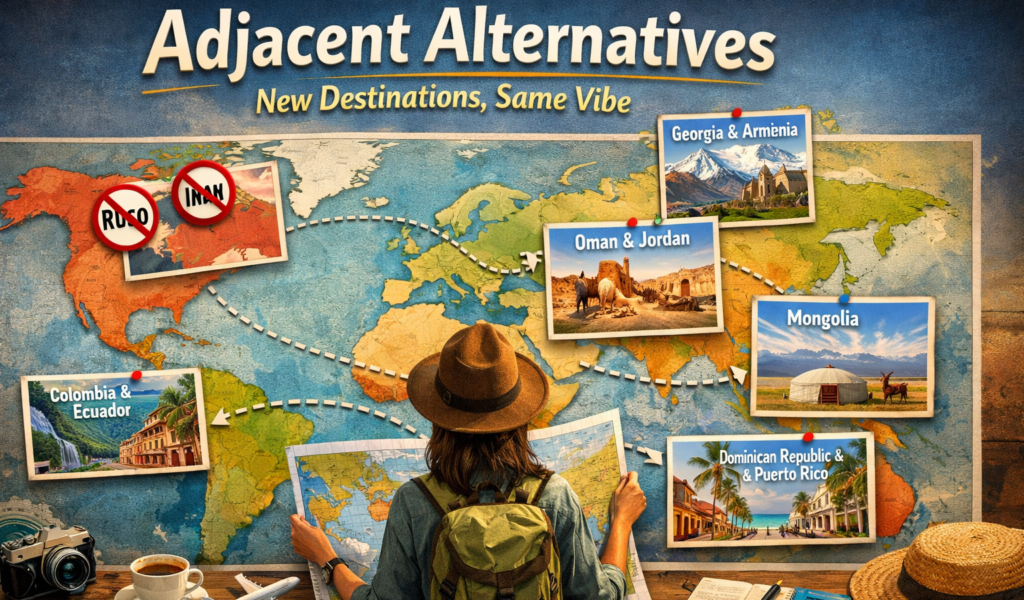
1) Instead of Russia: Visit Georgia (and Armenia)
If the dream was Russia, imperial architecture, Orthodox churches, mountain landscapes, Soviet-era history, intense food culture, Georgia and Armenia may actually be the better story.
Why it’s similar
The Caucasus region shares deep historical overlap with Russia and the former Soviet world. You’ll encounter:
- Dramatic mountain scenery (think: big skies and sharp ridgelines)
- Soviet “ghost architecture” and complex history
- Orthodox religious heritage and ancient monasteries
- A big emphasis on hospitality, wine, and long meals
Why you’ll love it more
Georgia’s capital Tbilisi is one of the most photogenic and atmospheric cities in the region with old stone balconies, hilltop fortresses, thermal baths, and modern creative districts.
Armenia delivers unforgettable day trips: Garni Temple, Geghard Monastery (UNESCO-listed), and Lake Sevan.
Traveler tip: Pair both countries in one trip. Overland travel between the two is common and the circuit is efficient for 10–14 days.
2) Instead of Iran: Visit Oman (or Jordan)
Iran’s appeal is undeniable: ancient civilizations, desert cities, bazaars, astonishing architecture, and cultural depth. But if politics makes Iran complicated, Oman and Jordan are two of the best adjacent alternatives on Earth.
Why it’s similar
Both offer:
- Desert landscapes and mountain scenery
- Deep Middle Eastern culture with strong hospitality traditions
- Forts, old cities, and “routes of history” travel
Why you should go
Oman is ideal for travelers who want authenticity without chaos—think wild coastline, forts, and desert nights.
Jordan delivers iconic history (Petra) and a natural “cinematic” landscape (Wadi Rum), without the same level of geopolitical friction many travelers worry about in Iran.
Traveler tip: If you’re a photographer, both destinations are light-and-shadow heaven—great for portraits, street scenes, and dramatic landscapes.
3) Instead of Venezuela: Visit Colombia (or Ecuador)
Venezuela has once-in-a-lifetime nature: Caribbean coastline, jungle rivers, and epic landscapes like Angel Falls. But political instability and security risks make it hard for U.S. travelers to visit responsibly.
The adjacent alternative? Colombia—and (quietly) Ecuador.
Why it’s similar
- Caribbean culture and coastal options
- Rainforest ecosystems and wildlife diversity
- Andean mountain cities
- Strong regional food traditions
Why it works
Colombia offers a wide range of travel styles: vibrant cities, cloud forests, coffee regions, and coastline without the same level of travel uncertainty.
Ecuador is the sleeper pick: an absurd concentration of environments (Amazon + Andes + coast) plus compact travel distances.
Traveler tip: If you wanted Venezuela for nature, you can create a wildlife-heavy itinerary in Colombia or Ecuador that’s just as rewarding—and much easier to plan.
4) Instead of Cuba’s restrictions: Visit the Dominican Republic (or Puerto Rico)
Cuba remains a fascination with classic cars, colorful streets, and a time-capsule cultural experience. But U.S. travel is still burdened by category compliance and paperwork. Now, with increased political issues, shortages of food, medicine, gasoline, and electricity, it is not a great choice.
If what you really want is the Caribbean vibe + culture + music + street photography, you have better options.
Why it’s similar
- Spanish-Caribbean heritage and architecture
- Music-first culture
- Warm, sociable street life
- Colonial-era city centers
Why these two are winners
The Dominican Republic is a full-spectrum destination: beaches, colonial history (Santo Domingo), mountains, and lively culture.
Puerto Rico offers gorgeous old-city photography (Old San Juan), plus rainforest day trips and easy logistics.
Traveler tip: If your goal is “Cuba-style” street images, spend extra time in historic districts, markets, and music neighborhoods instead of resorts.
5) Instead of North Korea: Visit Mongolia (or remote Central Asia)
For many travelers, North Korea isn’t just a destination. It’s a concept: isolation, extreme cultural difference, and “end of the map” vibes.
North Korea is essentially off-limits to Americans for practical reasons—but the adjacent alternative is not just safer, it’s actually more adventurous.
Why it’s similar
If what you want is:
- Remoteness
- Cultural intensity
- A feeling of “I am far from the world I know”
then Mongolia delivers that honestly.
Why Mongolia is better
Mongolia gives you:
- Nomadic culture
- Endless landscapes
- Horse travel and wilderness camps
- Big sky photography and star-filled nights
Traveler tip: Mongolia is tailor-made for adventurous photographers: people, landscapes, eagles, horses, and dramatic weather.
Bonus Destination That Deserves a Spotlight
Instead of “Closed” Silk Road zones: Visit Uzbekistan
If you’re chasing the romance of geopolitics,“old empires, caravans, bazaars, and ancient intrigue”, then Uzbekistan is the Silk Road destination that still feels like a revelation.
Why it stands out:
- The classic Silk Road cities: Samarkand, Bukhara, Khiva
- Mosaic-covered architecture and medieval trade history
Traveler tip: Uzbekistan is one of the few places where the “once-in-a-lifetime” feeling still hits hard—especially for first-time visitors to Central Asia.
The Bigger Lesson for 2026 Travelers
When politics complicates travel, it doesn’t have to kill the trip—it can actually improve it.
Adjacent alternatives are often:
- Less crowded
- Less expensive
- More welcoming
- More flexible for photographers and independent travelers
- More stable in day-to-day logistics
In short: the experience you’re chasing may exist next door—without the risk.
As always, when considering travel to one of the less-visited destinations, take current travel advisories into consideration
About The Author