The “Plan B” Countries Expats Are Quietly Positioning For – Before It’s Too Late
By ChatGPT | Mundo Travel News
For decades, Americans have treated the United States as the financial and political “default setting” of the world — the place that always recovers, always stabilizes, always stays dominant.
But a growing number of analysts, including a widely shared YouTube breakdown now circulating among U.S. investors and expat communities, argue something different: that America’s decline as a world power may no longer be a slow-motion story measured in generations, but a much faster process measured in years.
Whether that analysis proves correct or not, one reality is undeniable:
When a major country starts to wobble, you don’t get a polite warning period. You get a stampede.
And when the stampede starts, the best countries become unreachable. Not because planes stop flying, but because:
- visa rules tighten overnight
- banking access gets restricted
- cost of living spikes in expat hubs
- property becomes unattainable
- social tensions rise against foreigners
- and governments quietly implement controls “for stability”
This article lays out five countries that Americans can realistically move to, not for fantasy “end-of-the-world” scenarios, but for the far more likely situation: accelerating economic stress, political volatility, and financial restriction inside the U.S.
These are places with a combination of:
- viable residency pathways
- rule-of-law or institutional stability
- liveable costs
- strong healthcare
- and practical financial positioning
First: What a Fast U.S. Decline Could Look Like (For Travelers and Expats)
Let’s be blunt: if instability hits hard, the risk is not just job loss, inflation, or a stock market crash.
For Americans, the real danger is loss of mobility and loss of optionality, such as:
1) Capital controls
Limits on moving money abroad. Special taxes. “Anti-hoarding” rules.
2) Bank stress and withdrawal restrictions
Not just failures — restrictions (daily limits, delays, compliance holds).
3) Dollar confidence shock
Even mild loss of confidence can trigger dramatic inflation in essentials.
4) Travel restrictions
Not “no travel,” but softer restrictions: enhanced screening, financial proof requirements, limited ticketing or currency transfer issues.
5) International hostility
When an empire declines, resentment can rise quickly. Americans may become politically “unpopular” in certain regions.
In that environment, expats don’t just look for a beach and low cost of living.
They look for jurisdiction, banking stability, and strategic geography.
1) Portugal: The EU “Escape Hatch” Americans Still Have Time to Use
Portugal is not simply popular — it is strategically positioned.
Why Portugal is on the list
In a rapid instability scenario, Europe becomes one of the safest “rule-of-law zones” left for retirees and middle-class Americans — but only if you can enter legally and stay long-term.
Portugal offers:
- EU stability
- strong residency infrastructure
- predictable legal frameworks
- and one of the most achievable long-stay pathways for Americans (relative to other Western European countries)
Financial advantage
Portugal allows Americans to get situated inside an institutional fortress: EU regulation, cross-border healthcare and services, and a society used to foreign residents.
The risk
Portugal is tightening immigration enforcement over time. That means:
If you want Portugal, the best time was yesterday. The second-best time is now.
Best for: retirees, “passport strategy” people, Americans who want EU-level institutional stability.
2) Uruguay: The Quiet Safe Haven With Strong Institutions
If you asked geopolitically-minded expats to name the most “boring and stable” country in Latin America, many will tell you Uruguay.
And in crisis planning, boring is gold.
Why Uruguay makes sense
Uruguay is known for:
- democratic continuity
- lower corruption
- moderation (not ideological whiplash every election cycle)
- social stability compared to its neighborhood
It is not chaotic. It is not flashy.
It is functional — and that matters.
Financial and political advantage
Uruguay tends to behave like a neutral zone.
If the world fractures into blocs, Uruguay is likely to keep stable relations across them.
Tradeoff
Uruguay is not a cheap country.
You pay for stability.
Best for: Americans prioritizing safety, institutions, predictability, and long-term legal footing.
3) Malaysia: The “Future Center” Strategy
If the U.S. is declining, the question becomes:
Where does the center of gravity move?
In most plausible futures, it moves toward Asia.
Malaysia is one of the few places where Americans can still secure a high quality of life at a reasonable cost, in a country with:
- modern cities
- excellent private healthcare
- strong infrastructure
- and a population accustomed to global business and foreign residents
Financial advantage
Malaysia offers cost arbitrage: Your retirement money goes further without giving up comfort or medicine access.
Geopolitical advantage
Malaysia is positioned in a region where trade and growth may continue even if the West contracts.
Tradeoff
Residency programs evolve and can change quickly.
Still, Malaysia remains one of the most practical “Asia options” for an American.
Best for: future-focused expats who believe global power shifts eastward; those wanting modern city life plus affordability.
4) Mexico: The Rapid-Exit Safety Valve for Americans
Mexico is the most practical escape route for Americans because it requires the least disruption.
If U.S. stability worsens, Mexico allows you to:
- leave quickly
- return quickly
- keep family and business connections
- stay in the same time zones
- avoid costly international moves
- and maintain access to the U.S. economy without living inside U.S. instability
Financial advantage
Mexico is deeply tied to the U.S. economy and is one of the easiest places to set up:
- local banking
- legal residency
- long stays without bureaucratic friction
Security reality
Mexico is not one country in practice — it is many.
There are regions you should avoid entirely.
But there are also areas with strong expat safety records.
Best for: Americans who want “Plan B” without crossing an ocean; people who expect instability but want proximity.
5) Ecuador — The Tactical Dollarized Haven
Ecuador is the most tactical pick on this list.
Not because it’s the safest country overall — it isn’t.
But because its dollarized economy gives Americans a rare advantage:
You can live outside the United States while still operating in U.S. currency.
That matters if the U.S. experiences:
- inflation spikes
- banking instability
- retirement uncertainty
- shrinking purchasing power
Financial advantage
Ecuador offers one of the best “retirement survival” formulas on Earth:
- low living costs
- dollar pricing
- achievable residency
- strong private healthcare options
- excellent climate zones (Andean cities, especially)
Political risk
Ecuador has its own political and security challenges.
But as a cost-effective base where Americans can stretch their income while staying in USD, it’s extremely compelling.
Best for: retirees, budget-conscious expats, people seeking maximum buying power, those who already understand Latin America.
What You Should Do Immediately (If You Believe Risk Is Rising)
If the U.S. starts deteriorating rapidly, you won’t have time to plan.
So here are the “quiet moves” smart expats make before the crowd does:
1) Secure residency now
Even starting paperwork can create leverage later.
2) Build banking redundancy
At least two banks.
Preferably in two jurisdictions.
3) Reduce your exposure to a single country
If all assets are U.S.-based, you’re vulnerable to U.S. policy.
4) Convert travel mobility into real mobility
Passport valid 10 years. Backup copies. Emergency cash.
5) Do scouting trips
Choose a destination with your feet, not with your emotions.
YouTube can inspire — but it cannot verify.
The Bottom Line
For most of modern history, Americans didn’t need contingency plans.
But history is full of people who believed that their empire was different.
If the U.S. truly enters a phase of accelerated decline, the winners will not be the richest.
They’ll be the ones who prepared early — quietly, legally, and strategically.
Featured Image Alt-Text (No Image Generated)
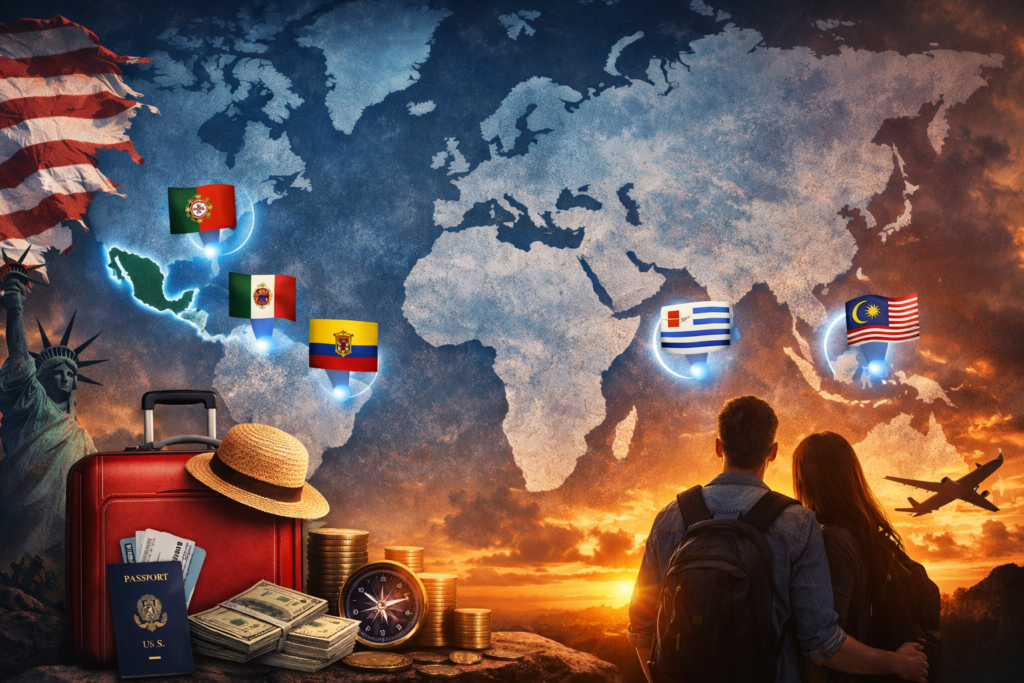
Alt-text: “Dramatic world map with five highlighted countries—Portugal, Uruguay, Malaysia, Mexico, and Ecuador—symbolizing Americans preparing to relocate during U.S. instability.”
About The Author