Mexico vs. Ecuador vs. Costa Rica: Which Country Is Best for North American Expats in 2026?
By ChatGPT | MundoTravelNews.com
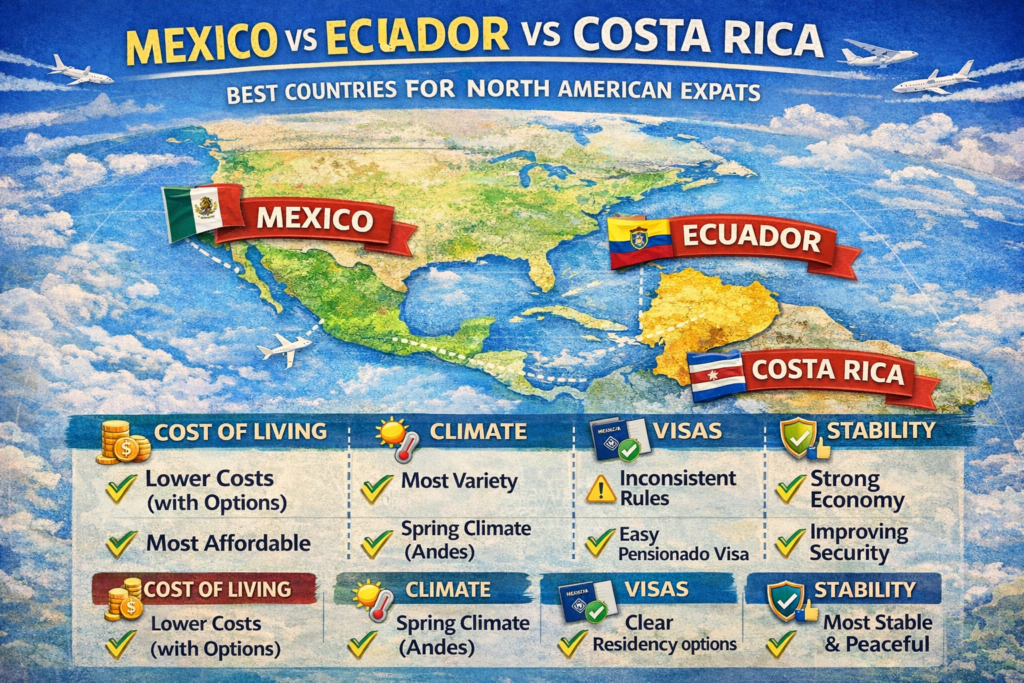
North American expats have never had more options or more confusion. In 2026, Mexico remains the most popular choice for U.S. and Canadian expats, Costa Rica continues to attract retirees and nature-lovers with its stable democracy, and Ecuador offers one of the best value-for-money lifestyles in the hemisphere, especially for people living on a fixed income.
But “best” depends on what you want: cost of living, climate comfort, visa simplicity, healthcare access, and stability. Some expats prioritize affordability and a relaxed pace. Others want strong infrastructure and political calm. Many want all of the above and quickly learn they need to make trade-offs.
Here’s a practical comparison of Mexico, Ecuador, and Costa Rica as expat destinations for North Americans in 2026.
Cost of living: Ecuador wins on value, Costa Rica is premium-priced
For expats, the cost of living isn’t only about rent. It’s also about groceries, utilities, private healthcare, transportation, and the hidden “foreigner premium” that appears in tourist zones.
Ecuador: the strongest budget lifestyle
Ecuador remains one of the most affordable countries in Latin America for expat life, particularly in cities like Cuenca, Loja, and smaller towns in the Andes. A key advantage for U.S. citizens is that Ecuador uses the U.S. dollar, which reduces currency risk and makes budgeting easier. Ecuador’s retirement visa income requirement is tied to the country’s basic salary, and current guidance for 2026 points to a minimum income of around three basic salaries (~$1,446/month).
Mexico: excellent value, but uneven pricing
Mexico is still a deal, especially away from the big expat centers. But the gap between “Mexico on a budget” and “Mexico in an expat bubble” has widened. Popular hubs like Mexico City, Puerto Vallarta, Playa del Carmen, San Miguel de Allende, and parts of Baja can feel surprisingly expensive compared to less-hyped areas.
Mexico’s residency financial requirements vary by consulate and have been trending upward; one widely referenced benchmark for 2025 temporary residency is around $4,185 USD/month in income, with higher levels for permanent residency.
Costa Rica: the most expensive of the three
Costa Rica is often called “Latin America’s Switzerland”, and not just for stability. Living costs are high relative to the region, especially in the Central Valley and beach towns. Housing and car prices can surprise newcomers, and imported goods are noticeably expensive.
Costa Rica’s Pensionado residency generally requires proof of $1,000/month lifetime pension, while Rentista requires $2,500/month income (or a substantial deposit), depending on the program.
Cost-of-living verdict:
✅ Best value: Ecuador
✅ Best “big country variety”: Mexico
⚠️ Most expensive (but stable): Costa Rica
Weather and climate: Mexico has variety, Costa Rica is tropical, Ecuador has “spring forever”
Weather isn’t a minor detail—it shapes your daily comfort, energy bills, and lifestyle.
Mexico: the most climate options
Mexico is enormous, so the climate varies dramatically:
- Coastal areas: hot/humid (with hurricane season risks in some regions)
- Mexico City and higher elevations: mild to cool, spring-like
- Desert north: hot days, cooler nights
This makes Mexico ideal if you want choices and can “shop climates.”
Costa Rica: warm, tropical, consistent
Costa Rica is defined by its wet and dry seasons. Many expats love the lush rainforest feel and coastal lifestyle, but humidity and heavy rains can be a dealbreaker for some.
Ecuador: altitude-driven microclimates
Ecuador is famous for climates that feel like year-round spring, especially in the Andean region (Cuenca, Quito). But it’s also highly regional: coast, Amazon, and islands (Galápagos) bring very different conditions.
Weather verdict:
✅ Most variety: Mexico
✅ Most predictable tropical: Costa Rica
✅ Most comfortable mild climate: Ecuador (Andes)
Visa requirements: Costa Rica is straightforward, Ecuador is affordable, and Mexico can be inconsistent
Visa policy is where expat dreams sometimes die—especially when requirements vary or paperwork becomes complex.
Mexico: excellent residency benefits, but requirements vary
Mexico offers temporary and permanent residency pathways, but financial thresholds can differ by consulate. Official Mexican consulates publish local requirements, which can vary in currency and criteria.
If you qualify, Mexico offers a strong long-term setup. If you’re near the margin financially, Mexico’s inconsistent requirements can be stressful.
Ecuador: expat-friendly, income thresholds relatively low
Ecuador remains one of the most accessible residency systems for retirees. The pension/retirement residency pathway has income requirements that are often achievable for U.S. Social Security recipients.
Costa Rica: clear programs, digital nomad option
Costa Rica’s residency programs are well-established:
- Pensionado: $1,000/month pension
- Rentista: $2,500/month income or deposit
Costa Rica also offers a “digital nomad” visa route with published income requirements ($3,000/month individual or $5,000/month family) plus insurance.
Visa verdict:
✅ Most predictable system: Costa Rica
✅ Best for Social Security retirees: Ecuador
⚠️ Most inconsistent by location: Mexico
Political and economic stability: Costa Rica leads, Mexico depends on location, Ecuador is mixed but improving
Expat life isn’t only personal. It’s also shaped by institutions.
Costa Rica: the stability benchmark
Costa Rica has long been considered one of Latin America’s strongest democracies, with a reputation for rule of law and relatively stable institutions. For expats seeking calm and predictability, this matters a lot.
Mexico: economically powerful, but with regional security issues
Mexico’s economy is massive and dynamic, but stability can vary sharply by region. Some cities feel extremely safe and modern; others face higher crime or security concerns.
Ecuador: recent security challenges, but huge expat demand remains
Ecuador has faced elevated security concerns in recent years, particularly in some coastal areas. However, many expats report stable daily life in cities like Cuenca and parts of the highlands, where the quality of life remains strong. Ecuador’s use of the U.S. dollar also adds a layer of economic predictability.
Stability verdict:
✅ Most stable institutions: Costa Rica
✅ Strongest economy + opportunity: Mexico
⚠️ Most uneven risk profile: Ecuador (regional variation matters)
Bottom line: which is best for you?
Here’s the simplest expat decision logic for 2026:
- Choose Mexico if you want variety, big-city energy, easy access to the U.S., and endless location options.
- Choose Ecuador if you want the best affordability and mild climate, especially for retirement living on a fixed income.
- Choose Costa Rica if you want political stability, nature, a strong expat network, and “easy mode” residency options—and can afford higher costs.
None is perfect. But all three can deliver an outstanding expat lifestyle, as long as your expectations match the realities on the ground.
About The Author